
Understanding the 5 J/cm² Fluence Window: Optimal Energy for Aircraft Paint Removal
What is Fluence?
Fluence is the energy density delivered by a laser pulse, measured in joules per square centimeter (J/cm²). It's the single most important parameter for predicting whether a laser will clean, polish, or damage a surface. The formula is simple:
Fluence (J/cm²) = Pulse Energy (J) / (0.785 × d²), where d is the spot diameter in cm.
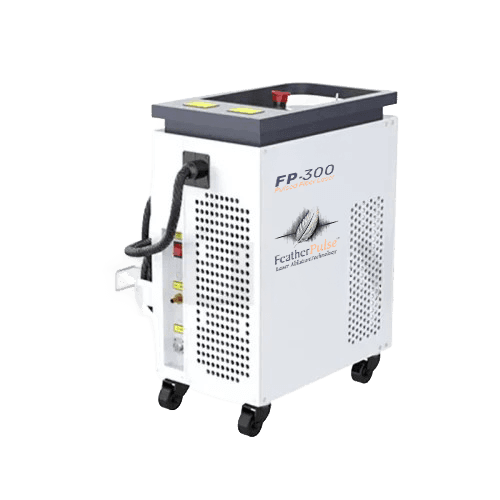
If your FP-300 is set to 200 W average power at 40 kHz with a 0.8 mm spot, each pulse contains 5 mJ over a 0.005 cm² area — about 1 J/cm² per pulse. With overlap and multiple passes, the effective fluence on the workpiece climbs to the operational range.
Industry-Validated Thresholds
Years of published research and MRO field data have produced a consensus set of fluence thresholds for aviation surfaces:
- Oxide film removal: 1.43 – 1.82 J/cm²
- Light corrosion / surface bloom: 2 – 4 J/cm²
- Primer (BMS10-11 type): 5.09 J/cm² (Boeing's reference)
- Acrylic polyurethane topcoat: 17.7 J/cm²
- Aluminum substrate damage: 24.8 J/cm²
The optimal cleaning window for most aviation work falls between 5 and 20 J/cm². Below 5, you're not removing primer effectively. Above 20, you're approaching the substrate damage threshold and the safety margin starts shrinking.
Why 5 J/cm² is the Sweet Spot
At 5 J/cm² with the FP-300's standard 0.8 mm spot:
- Paint absorbs about 4.25 J/cm² — well above its 2 J/cm² ablation threshold, so removal is clean and complete
- Aluminum absorbs about 0.4 J/cm² — a safety factor of 62× below its damage threshold
- Heat penetration stays below 0.2 μm per pulse — negligible compared to substrate thickness
- Surface roughness lands in the Ra 0.8–1.6 μm range — ideal for primer adhesion on the recoat
Warning Signs You're Over the Limit
Operators should learn to recognize when fluence is too high. The clearest tells:
- Surface waviness or "petal" deformation appearing on thin skin panels
- Substrate color changes — a hint of yellow or bronze instead of the normal satin aluminum tone
- Excessive heat buildup — surface temperature climbing past 120 °C between passes
- Audible difference — a sharper "snap" sound on each pulse instead of the soft sizzle of normal cleaning
If any of these appear, drop power 10–20 % immediately. Excessive fluence (above 6 J/cm²) on aluminum substrates can promote fretting fatigue, particularly around rivet areas — the very type of damage Shane Bowen discovered after years of chemical stripping.
How to Adjust Fluence Without Changing Power
Operators sometimes want more energy on the workpiece without cranking the power dial. There are three other levers:
- Lower the frequency — fewer pulses per second concentrates more energy per pulse. Going from 45 kHz to 25 kHz roughly doubles fluence per pulse at the same average power.
- Tighten the spot size — a smaller focal diameter packs the same pulse energy into a smaller area, raising fluence quadratically.
- Slow the scan — dwelling longer on a given spot stacks more pulses on the same area, increasing total accumulated fluence.
The first option (frequency reduction) is the safest first move when you need a fluence bump. It increases energy per pulse without adding average heat to the workpiece.
Document Everything
Fluence isn't just an academic number. For FAA-compliant maintenance documentation, the parameter set you use — power, frequency, pulse duration, spot diameter, scan speed — should appear on the maintenance release alongside the cleaning method. That's how you prove, years later, that the laser process you used stayed within the validated safe envelope.